
Choosing the right CRM platform is a critical decision for sales teams, managers, and business owners. The right solution can directly impact your sales performance, streamline your workflow, and drive business growth. In this article, we present a comprehensive ‘noCRM vs Salesforce’ comparison, specifically tailored for sales teams. We’ll help you understand how each platform aligns with your sales process, team size, and business objectives—so you can make an informed choice that supports your goals.
What you’ll find in this article:
- noCRM is built for salespeople who need speed and simplicity, not for managers who want complex reporting
- Salesforce offers enterprise-grade capabilities but comes with significant setup time and hidden costs
- Setup comparison: noCRM takes minutes, Salesforce typically takes weeks
- For prospecting-heavy teams, noCRM’s Lead Clipper and native VoIP integrations provide a distinct advantage
- Choose based on your priority: speed and simplicity vs. comprehensive customization options
At a Glance: noCRM vs Salesforce Comparison
Below is a summary table highlighting the main features, strengths, and ideal use cases for noCRM and Salesforce:
| Feature/Aspect | noCRM | Salesforce |
|---|---|---|
| Definition | Lead management software designed to help salespeople convert leads into customers and organize their sales process | Feature-rich CRM solution with extensive customization capabilities |
| Key Features | Lead-centric workflow, quick lead capture, visual pipelines, native and no-code integrations, basic reporting | Advanced customization, automation, reporting, marketing, and customer support tools |
| Ideal For | Solopreneurs, small to mid-sized businesses, telemarketing teams focused on lead management and sales tracking | Larger enterprises or businesses with complex requirements and need for scalability |
| Strengths | Fast setup, intuitive interface, sales-focused, minimal admin overhead | Extreme flexibility, depth of customization, suitable for complex industries |
| Limitations | Limited marketing features | Higher setup time and cost, steeper learning curve |
| Best Use Case | Teams prioritizing lead management, sales tracking, and quick adoption to focus on sales | Organizations needing marketing and scaling |
What Makes These CRM Platforms Unique?
Before diving into the unique characteristics of each platform, let’s define what noCRM and Salesforce are, and who they are best suited for:
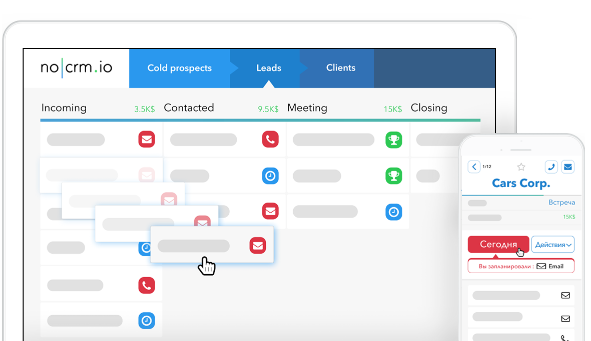
noCRM is a lead management software designed to help salespeople convert leads into customers and organize their sales process. Its key features include a lead-centric workflow, quick lead capture options, visual pipelines, and native and no-code integrations. noCRM is an excellent choice for small to mid-sized businesses focused on lead management and sales tracking. However, it primarily focuses on lead management and sales tracking, potentially lacking functionality in areas like marketing automation and customer support.
Salesforce is a feature-rich CRM solution with extensive customization capabilities. It is known for its extreme depth of customization, making it suitable for complex industries such as healthcare and government. Salesforce is ideal for larger enterprises or businesses with complex requirements due to its comprehensive features. However, the platform is complex and typically requires a longer implementation time, often measured in weeks or months.
Now, let’s explore what makes each platform unique and how their design philosophies impact your sales workflow.
noCRM – The Anti-CRM Approach
noCRM launched around 2014 with a bold philosophy: most CRMs are built for managers, not salespeople. The platform deliberately strips away the administrative overhead that slows down sales teams, focusing exclusively on lead management and pipeline velocity.
This lead management software is designed for salespeople first. Unlike traditional CRM systems that require extensive data entry and complex workflows, noCRM treats simplicity as a feature, not a limitation.
The target audience? Prospecting-heavy sales teams who need speed over features, growing sales teams tired of fighting their software, and solopreneurs who want to manage leads without the bloat.
The Complexity Matrix: What noCRM Simplifies
noCRM achieves its efficiency by focusing on what salespeople actually need:
- No endless manual field entry – create leads in seconds, log calls and notes freely
- No complex admin setup – zero IT involvement, self-onboarding in minutes
- No overwhelming dashboards – replaced by a clear dashboard and a pipeline view
- No over-engineered reporting – focus stays on selling, not generating reports
Real-world users report faster lead processing compared to traditional CRM systems. This isn’t about lacking capabilities, it’s about focusing on everything that directly helps close deals.
Salesforce CRM – Enterprise-Grade CRM
Salesforce is a comprehensive suite of products spanning CRM, customer success, marketing automation, commerce, Data 360, and more. Since 1999, Salesforce has grown to serve over 150,000 customers worldwide, processing billions of transactions daily.
Salesforce Sales Cloud offers extensive customization through Apex (a Java-like programming language), Visualforce for custom UIs, and Lightning components for modern interfaces. This development flexibility enables intricate workflows, custom objects, and role-based access controls.
The platform targets larger organizations requiring complex sales processes and detailed analytics. Advanced reporting, AI-powered insights through Einstein, and robust automation capabilities make it powerful for enterprise needs.
The trade-off? This is a manager-focused platform designed for complex reporting needs. The same features that enable deep customization also create steep implementation timelines, often measured in weeks or months.
Now that you understand the core philosophies and unique strengths of noCRM and Salesforce, let’s compare them head-to-head across the most important criteria for sales teams.
noCRM vs Salesforce: Head-to-Head Comparison
Setup Time and Implementation
noCRM Setup
- Users report going from signup to operational status in minutes
- No setup fee, no IT involvement required, and no consultant needed
- Your team can start managing leads immediately
Salesforce Setup
- Configuration layers including process builders, flow automations, and custom objects typically require 4-12 weeks of setup time
- Many organizations invest thousands in initial consulting before the platform becomes usable
For small businesses and growing teams, this difference in proceeding to productivity matters significantly.
User Interface and Ease of Use
noCRM Interface
- Designed with a strong focus on lead management and sales activity
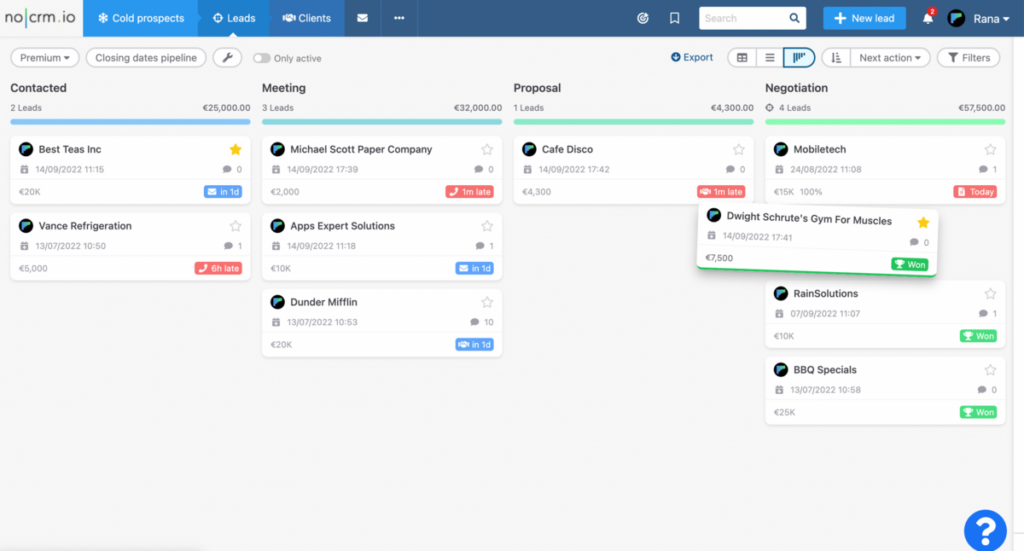
- Streamlined interface centered on prospects, leads, pipelines, and follow-ups
- Layout emphasizes simplicity and quick access to essential actions such as calling, emailing, and updating lead status
- Android users rate the noCRM app highly for its straightforward design and ease of navigation
Salesforce Interface
- Built to support a wide range of business processes and advanced workflows
- Provides extensive dashboards, reporting tools, and configuration options for deep data analysis and system customization
- The Salesforce Android app receives mixed feedback, often reflecting the balance between functionality and usability
Interface design plays an important role in user adoption. Tools that are perceived as overly complex may face resistance, especially among users who only need core sales features. At the same time, platforms that prioritize simplicity may be easier to adopt but can be limiting for teams with more advanced operational requirements. Ultimately, effective adoption depends on how well the system’s design aligns with the organization’s workflows, data needs, and long-term goals.
Sales Process Focus, Inbound vs. Outbound Capabilities
noCRM Advantages:
- Lead Clipper captures leads from emails, LinkedIn, or any webpage instantly
- Prospecting Lists are separated from the Leads pipeline, keeping cold outreach organized
- Native VoIP integrations (like CloudTalk, Aircall, Justcall) log interactions in real-time
- Email integration connects your inbox directly to noCRM
- Invoices and quotes let you close the sale without leaving the platform
This end-to-end focus means salespeople can prospect, nurture, and close deals in one place.
Salesforce Capabilities:
- Excels at broader inbound and outbound capabilities, with tools like Pardot for marketing automation and comprehensive opportunity stages
- These capabilities often require separate modules and additional configuration to function together
Integration Ecosystem
noCRM Integrations
- Embraces a best-of-breed approach
- Offers native integrations with popular tools
- Connects to 5,000+ apps through Zapier and open APIs
- Integrates with Gmail, Outlook, Google Sheets, Trello, QuickBooks, Slack, WhatsApp, and more
- No vendor lock-in or custom development required
Salesforce Integrations
- AppExchange boasts 7,000+ native integrations, creating a comprehensive but complex ecosystem
- Deep ERP ties and enterprise connections are powerful, but often require middleware and technical expertise to implement properly
The flexibility vs. complexity trade-off is real: noCRM lets you stack tools modularly with minimal technical overhead, while Salesforce offers deeper integration at the cost of increased complexity.
Pricing and Total Cost of Ownership
Free vs. Hidden Costs Comparison
| Factor | noCRM | Salesforce |
|---|---|---|
| Feature Focus | Focused exclusively on sales essentials | Suite with marketing, service, and sales tools included |
| Setup Time | Minutes to operational | Weeks of configuration (4-12 weeks typical) |
| Setup Costs | Zero setup fees | Often thousands in consulting fees before the platform becomes usable |
| Ongoing Admin | Self-service, no IT needed | Dedicated admin salary often required |
| Training Requirements | Intuitive interface, minimal training | Extensive training programs needed |
| Hidden Costs | Transparent, all-inclusive tiers | Add-ons for advanced features and integrations |
Platform Pricing Breakdown
noCRM Pricing:
- Starter: $13/user/month – lead tracking and pipeline management
- Expert: $26/user/month – adds team collaboration and Zapier integrations
- Dream: $39/user/month – includes advanced prospecting lists and VoIP integrations
All tiers include 15-day trials with no credit card required.
Salesforce CRM Pricing:
- Free Suite: Available for up to 2 users
- Starter Suite: $25/user/month for core CRM capabilities
- Pro Suite: $100/user/month for advanced features
The difference in total cost of ownership can reach 5-10x when factoring in Salesforce’s implementation, training, ongoing administration, and add-on costs. For a 10-person sales team, noCRM’s Dream tier costs under $5,000 annually, while a comparable Salesforce implementation often exceeds $20,000 when all costs are included.
Now that you’ve seen how noCRM and Salesforce compare across setup, usability, integrations, and cost, let’s hear what real sales teams have to say about their experiences with each platform.
What Sales Teams Say About Each Platform
noCRM Users Love
- Speed of lead entry – Lead Clipper creates prospects from any webpage in seconds; mobile app scans business cards to instantly create new leads
- Sales-focused features – Everything serves the goal of closing deals faster
- Immediate productivity – Teams report being operational within the first hour
- No administrative overhead – Salespeople sell instead of managing their CRM
- Reliability – The platform does exactly what it promises without feature bloat
- Responsive customer support – Quick answers without enterprise sales pressure
Users consistently praise noCRM for its efficiency and focus on simplifying the sales process, particularly for small businesses seeking a streamlined lead management solution.
Salesforce Users Love
- Comprehensive reporting – Deep analytics and performance dashboards for management
- Advanced automation – Complex workflow automation with Einstein AI capabilities
- Customization capabilities – Build exactly the CRM your organization needs
- Enterprise integrations – Connect with existing corporate systems seamlessly
- Scalability – The platform grows with even the largest organizations
- Ecosystem depth – Access to thousands of apps and extensions
Salesforce offers strong scalability for mid-market businesses and delivers robust reporting capabilities. Enterprise organizations with dedicated administrative resources particularly appreciate the comprehensive features it provides.
Understanding user feedback is crucial, but it’s also important to know what’s required to implement and maintain each platform. The next section breaks down the practical requirements for both noCRM and Salesforce.
Implementation Requirements Overview
| Requirement | noCRM | Salesforce |
|---|---|---|
| Technical Setup | Minimal, sign up and start using | More complex configuration, custom objects, workflow rules |
| Training Needs | Brief orientation on lead management workflow | Extensive programs for users and administrators |
| Ongoing Maintenance | Self-service updates, no IT support needed | Regular updates, custom development |
| Time to Value | Same day | Weeks to months depending on complexity |
For teams without dedicated IT resources, this difference in requirements represents a significant decision factor.
Which CRM Platform is Right for Your Sales Team?
Choose noCRM if you want:
- Fast implementation and immediate results without weeks of setup
- Focus on prospecting and lead conversion over complex reporting
- Minimal administrative overhead and technical requirements
- Cost-effective solution with transparent, predictable pricing
- A platform built for salespeople, not sales managers
- Native VoIP and email integrations for prospecting-heavy workflows
- Ability to send invoices and quotes without leaving the platform
Choose Salesforce if you want:
- Comprehensive CRM with advanced customization options
- Complex reporting and analytics for management oversight
- Enterprise-level integrations and scalability
- AI-powered insights through Einstein for predictive analytics
- A complete suite including marketing, service, and commerce tools
The Anti-CRM Verdict
The Bottom Line: “Salesforce is designed for managers requiring complex reporting; noCRM is designed for salespeople who need speed.”
This comparison isn’t about one platform being better than the other. It’s about matching your CRM to how your team actually works.
If your biggest advantage comes from quick lead follow-up, minimal data entry, and keeping salespeople focused on selling, noCRM delivers exactly that. Its deliberate simplicity removes the friction that causes CRM abandonment.
If your organization needs detailed forecasting, complex approval workflows, AI-powered analytics, and deep enterprise integration, Salesforce provides capabilities that simpler platforms cannot match.
The best CRM is the one your team will actually use. Every feature your salespeople ignore represents wasted investment. Every minute spent on data entry instead of selling costs you opportunities.
Make your decision based on what drives results for your specific sales process, not on which platform has more features.
Want to experience noCRM today? Enjoy a 15-day free trial of noCRM now.
FAQ
Small businesses often struggle with the implementation complexity and hidden costs. The platform’s power shines brightest in larger organizations with dedicated admin resources.
Yes. noCRM’s import tools make migration straightforward. Salesforce supports data export in standard formats.
noCRM has gained significant traction with remote-first sales teams since 2020, particularly for outbound prospecting. Its low-friction design suits distributed teams well.
